pivotlb module
Module with PIVOTLB.
PIVOTLB class
PIVOTLB(
    wrapper,
    input_list,
    input_mapper,
    in_output_list,
    output_list,
    param_list,
    mapper_list,
    short_name,
    **kwargs
)
Label generator based on pivots_nb.
Superclasses
- Analyzable
- AttrResolverMixin
- Base
- Cacheable
- Chainable
- Comparable
- Configured
- ExtPandasIndexer
- HasSettings
- HasWrapper
- IndexApplier
- IndexingBase
- IndicatorBase
- ItemParamable
- Itemable
- PandasIndexer
- Paramable
- Pickleable
- PlotsBuilderMixin
- Prettified
- StatsBuilderMixin
- Wrapping
vectorbtpro.labels.generators.pivotlb.ParamIndexer
Inherited members
- AttrResolverMixin.deep_getattr
- AttrResolverMixin.post_resolve_attr
- AttrResolverMixin.pre_resolve_attr
- AttrResolverMixin.resolve_attr
- AttrResolverMixin.resolve_shortcut_attr
- Base.chat
- Base.find_api
- Base.find_assets
- Base.find_docs
- Base.find_examples
- Base.find_messages
- Cacheable.get_ca_setup
- Chainable.chain
- Chainable.pipe
- Configured.copy
- Configured.equals
- Configured.get_writeable_attrs
- Configured.prettify
- Configured.replace
- Configured.resolve_merge_kwargs
- Configured.update_config
- HasSettings.get_path_setting
- HasSettings.get_path_settings
- HasSettings.get_setting
- HasSettings.get_settings
- HasSettings.has_path_setting
- HasSettings.has_path_settings
- HasSettings.has_setting
- HasSettings.has_settings
- HasSettings.reset_settings
- HasSettings.resolve_setting
- HasSettings.resolve_settings_paths
- HasSettings.set_settings
- HasWrapper.chunk
- HasWrapper.chunk_apply
- HasWrapper.get_item_keys
- HasWrapper.select_col
- HasWrapper.select_col_from_obj
- HasWrapper.should_wrap
- HasWrapper.split
- HasWrapper.split_apply
- HasWrapper.ungroup
- IndexApplier.add_levels
- IndexApplier.drop_duplicate_levels
- IndexApplier.drop_levels
- IndexApplier.drop_redundant_levels
- IndexApplier.select_levels
- IndexingBase.indexing_setter_func
- IndicatorBase.cls_dir
- IndicatorBase.column_only_select
- IndicatorBase.column_stack
- IndicatorBase.config
- IndicatorBase.dropna
- IndicatorBase.fix_docstrings
- IndicatorBase.get
- IndicatorBase.group_select
- IndicatorBase.iloc
- IndicatorBase.in_output_names
- IndicatorBase.indexing_func
- IndicatorBase.indexing_kwargs
- IndicatorBase.input_names
- IndicatorBase.items
- IndicatorBase.lazy_output_names
- IndicatorBase.level_names
- IndicatorBase.loc
- IndicatorBase.main_output
- IndicatorBase.output_flags
- IndicatorBase.output_names
- IndicatorBase.param_defaults
- IndicatorBase.param_names
- IndicatorBase.plots_defaults
- IndicatorBase.range_only_select
- IndicatorBase.rec_state
- IndicatorBase.rename
- IndicatorBase.rename_levels
- IndicatorBase.row_stack
- IndicatorBase.run_pipeline
- IndicatorBase.self_aliases
- IndicatorBase.short_name
- IndicatorBase.stats_defaults
- IndicatorBase.to_dict
- IndicatorBase.to_frame
- IndicatorBase.unpack
- IndicatorBase.unwrapped
- IndicatorBase.wrapper
- IndicatorBase.xloc
- ItemParamable.as_param
- PandasIndexer.xs
- Pickleable.decode_config
- Pickleable.decode_config_node
- Pickleable.dumps
- Pickleable.encode_config
- Pickleable.encode_config_node
- Pickleable.file_exists
- Pickleable.getsize
- Pickleable.load
- Pickleable.loads
- Pickleable.modify_state
- Pickleable.resolve_file_path
- Pickleable.save
- PlotsBuilderMixin.build_subplots_doc
- PlotsBuilderMixin.override_subplots_doc
- PlotsBuilderMixin.plots
- PlotsBuilderMixin.resolve_plots_setting
- Prettified.pprint
- StatsBuilderMixin.build_metrics_doc
- StatsBuilderMixin.override_metrics_doc
- StatsBuilderMixin.resolve_stats_setting
- StatsBuilderMixin.stats
- Wrapping.apply_to_index
- Wrapping.regroup
- Wrapping.resample
- Wrapping.resolve_column_stack_kwargs
- Wrapping.resolve_row_stack_kwargs
- Wrapping.resolve_self
- Wrapping.resolve_stack_kwargs
Subclasses
vectorbtpro.labels.generators.pivotlb._PIVOTLB
apply_func method
Apply function.
cache_func NoneType
Cache function.
custom_func method
IndicatorFactory.with_apply_func.<locals>.custom_func(
    input_tuple,
    in_output_tuple,
    param_tuple,
    *_args,
    input_shape=None,
    per_column=False,
    split_columns=False,
    skipna=False,
    return_cache=False,
    use_cache=True,
    jitted_loop=False,
    jitted_warmup=False,
    param_index=None,
    final_index=None,
    single_comb=False,
    execute_kwargs=None,
    **_kwargs
)
Custom function.
down_th_list class property
List of down_th values.
high class property
Input array.
high_above method
Return True for each element where high is above other.
See combine_objs.
high_below method
Return True for each element where high is below other.
See combine_objs.
high_crossed_above method
Return True for each element where high is crossed_above other.
See combine_objs.
high_crossed_below method
Return True for each element where high is crossed_below other.
See combine_objs.
high_equal method
Return True for each element where high is equal other.
See combine_objs.
high_stats method
Stats of high as generic.
labels class property
Output array.
labels_above method
Return True for each element where labels is above other.
See combine_objs.
labels_below method
Return True for each element where labels is below other.
See combine_objs.
labels_crossed_above method
Return True for each element where labels is crossed_above other.
See combine_objs.
labels_crossed_below method
Return True for each element where labels is crossed_below other.
See combine_objs.
labels_equal method
Return True for each element where labels is equal other.
See combine_objs.
labels_stats method
Stats of labels as generic.
low class property
Input array.
low_above method
Return True for each element where low is above other.
See combine_objs.
low_below method
Return True for each element where low is below other.
See combine_objs.
low_crossed_above method
Return True for each element where low is crossed_above other.
See combine_objs.
low_crossed_below method
Return True for each element where low is crossed_below other.
See combine_objs.
low_equal method
Return True for each element where low is equal other.
See combine_objs.
low_stats method
Stats of low as generic.
param_select_func_nb method
Parameter selection function.
plot method
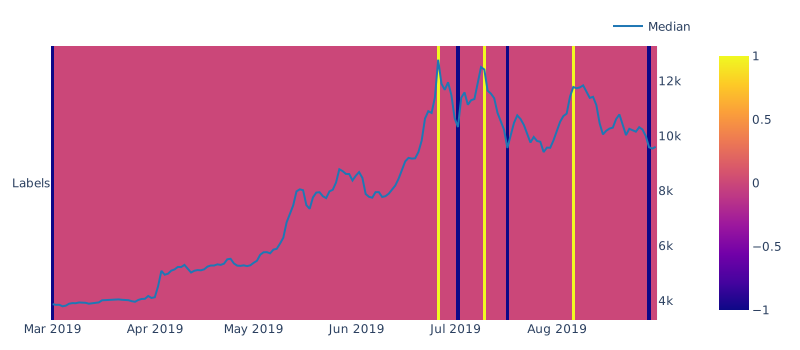
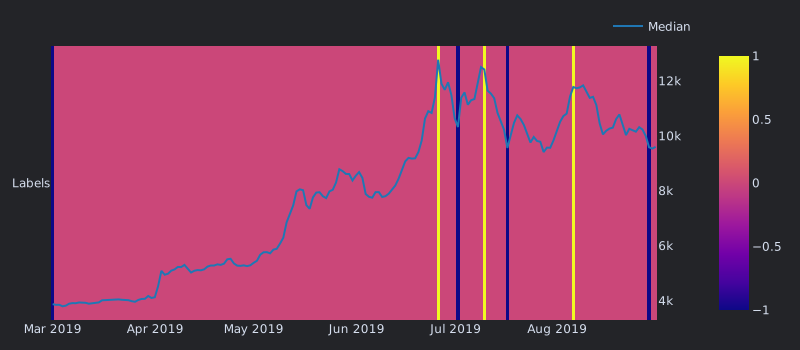
Plot the median of PIVOTLB.high and PIVOTLB.low, and overlay it with the heatmap of PIVOTLB.labels.
**kwargs are passed to GenericAccessor.overlay_with_heatmap.
Usage
run class method
PIVOTLB.run(
    high,
    low,
    up_th,
    down_th,
    short_name='pivotlb',
    hide_params=None,
    hide_default=True,
    **kwargs
)
Run PIVOTLB indicator.
- Inputs:
high,low - Parameters:
up_th,down_th - Outputs:
labels
Pass a list of parameter names as hide_params to hide their column levels, or True to hide all. Set hide_default to False to show the column levels of the parameters with a default value.
Other keyword arguments are passed to IndicatorBase.run_pipeline.
run_combs class method
PIVOTLB.run_combs(
    high,
    low,
    up_th,
    down_th,
    r=2,
    param_product=False,
    comb_func=itertools.combinations,
    run_unique=True,
    short_names=None,
    hide_params=None,
    hide_default=True,
    **kwargs
)
Create a combination of multiple PIVOTLB indicators using function comb_func.
- Inputs:
high,low - Parameters:
up_th,down_th - Outputs:
labels
comb_func must accept an iterable of parameter tuples and r. Also accepts all combinatoric iterators from itertools such as itertools.combinations. Pass r to specify how many indicators to run. Pass short_names to specify the short name for each indicator. Set run_unique to True to first compute raw outputs for all parameters, and then use them to build each indicator (faster).
Other keyword arguments are passed to PIVOTLB.run.
Note
This method should only be used when multiple indicators are needed. To test multiple parameters, pass them as lists to PIVOTLB.run.
up_th_list class property
List of up_th values.